
Oil sheds early gains as caution returns over Omicron curbs
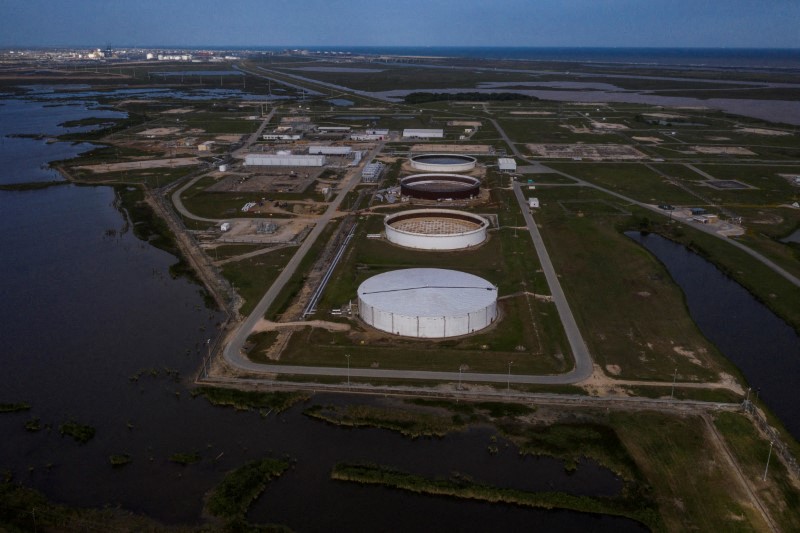
© Reuters. FILE PHOTO: The Bryan Mound Strategic Petroleum Reserve, an oil storage facility, is seen in this aerial photograph over Freeport, Texas, U.S., April 27, 2020. REUTERS/Adrees Latif/File Photo
By Mohi Narayan
NEW DELHI (Reuters) -Oil prices shrugged off early gains on Thursday as countries imposed new travel curbs to combat surging cases, though the downside remained capped over positive developments around COVID-19.
U.S. West Texas Intermediate (WTI) crude futures were down 12 cents, or 0.1%, to $72.62 a barrel at 0810 GMT after jumping 2.3% in the previous session.
Brent crude futures fell 18 cents, or 0.1%, to $75.11 a barrel, after a 1.8% gain in the previous session.
The big gains on Wednesday were partly spurred by a larger-than-expected drawdown in U.S. crude stockpiles last week.
“Markets have welcomed the steady flow of encouraging news on the Omicron front this week, with investors gradually regaining their risk appetite,” said Vandana Hari, energy analyst at Vanda (NASDAQ:VNDA) Insights, who added that sentiment could switch direction again.
The United States authorized Pfizer Inc (NYSE:PFE)’s antiviral COVID-19 pill for people ages 12 and older, the first oral and at-home treatment as well as a new tool against the fast-spreading Omicron variant.
Meanwhile, AstraZeneca (NASDAQ:AZN) said a three-dose course of its COVID-19 vaccine is effective against the Omicron coronavirus variant, citing data from an Oxford University lab study.
“In the latest rebound, the gains in WTI futures have outpaced those in Brent, shrinking the spread between the two,” Hari added.
On the flip side, governments reimposed a range of restrictions to slow the spread of Omicron. The Chinese city of Xian on Wednesday ordered its 13 million residents to stay home, while Scotland imposed gathering limits from Dec. 26 for up to three weeks, and two Australian states reimposed mask mandates as cases surged.
However, fears over the potential impact of mobility restrictions on fuel demand have receded because the Organization of the Petroleum Exporting Countries (OPEC), Russia and allies, together called OPEC+, has left the door open to reviewing their plan to add 400,000 barrels per day of supply in January.
“The threat of OPEC+ action has receded dramatically now that Brent crude is back above $75 a barrel, with $80 a barrel being the sweet spot for the grouping,” OANDA analyst Jeffrey Halley said in a note.